






Rome holds more first-rank sights than any visitor can cover in a single trip — 2,700 years of history, 900 churches, seven hills, and a density of art and archaeology unmatched anywhere in the world. The tours below are organised by what you want from the city: the monuments of the ancient centre, the art of the Vatican and the Galleria Borghese, the food and neighbourhoods that make Rome a pleasure to be in, the day trips that reach from thirty minutes away to the Bay of Naples, and the formats — private, small-group, skip-the-line — that shape how you see all of it.
Ancient Rome
The heart of the ancient city sits in a single cluster: the Colosseum, the Roman Forum and Palatine Hill share one combined ticket and one walking route, best done in that order. Beyond the standard admission lie the premium access experiences — the arena floor, the underground hypogeum, and the gladiator experience. Nearby, the Circus Maximus, the Castel Sant’Angelo and the catacombs of the Appian Way complete the ancient circuit, while Ostia Antica, Rome’s remarkably preserved port city, sits just thirty minutes from the centre.
The Vatican
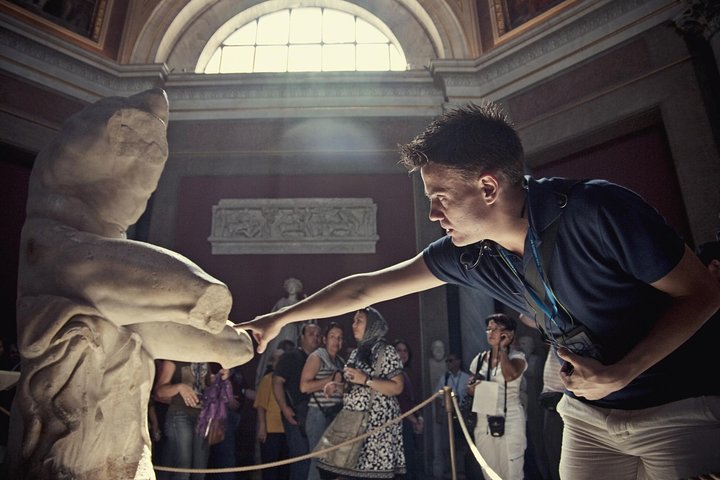
The Vatican Museums hold one of the world’s greatest art collections across miles of galleries, culminating in Michelangelo’s Sistine Chapel. Adjacent, but a separate building with its own entrance, St Peter’s Basilica is the largest church in the world. The single biggest improvement you can make to a Vatican visit is timing: an early morning tour reaches the Sistine Chapel in relative quiet, before the general public arrives.
Art & the Baroque Centre
The finest small museum in Rome, the Galleria Borghese, holds Bernini’s greatest sculptures and three Caravaggios, and cannot be visited without an advance reservation. It sits within the Villa Borghese gardens, Rome’s largest park. In the historic centre, the Pantheon remains the best-preserved building of antiquity, while Piazza Navona, the Trevi Fountain and the Spanish Steps form a compact baroque cluster within easy walking distance of one another.
Neighbourhoods & Walking Tours
Rome rewards walking more than almost any city, and its neighbourhoods reward it as much as its monuments. A guided walking tour is the most direct way to read the layered centre, from the Jewish Ghetto and Campo de’ Fiori to Trastevere across the river, the Gianicolo above it, and the Aventine keyhole with its famous framed view of St Peter’s. For first-time visitors, a welcome and orientation tour on the first morning is the highest-return few hours available — it sets up everything that follows.
Food, Wine & Cooking
Roman cooking is distinct from the rest of Italian food culture — simpler than Tuscan, more pork-focused than Venetian, and shaped by the traditions of Europe’s oldest Jewish community and the cucina povera of the city’s working-class quarters. A food tour is the most efficient way to understand it, with street food tours and wine tasting covering the informal and the serious ends. To take the skills home, there are hands-on cooking classes, pasta making and pizza making — and for the city’s best cheap pleasure, a gelato tour that teaches you to tell the good from the industrial.
Rome by Vespa, Bike & Boat
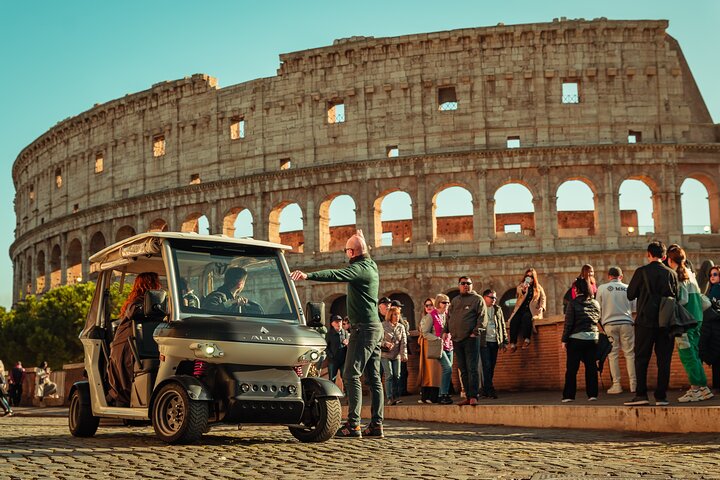
For a different relationship with the city’s fabric, a Vespa sidecar or vintage Fiat 500 tour moves through Rome the way Romans do, and an e-bike tour covers ground from the Appian Way to the Villa Borghese with the hills taken care of. A golf cart tour reaches the pedestrianised centre that coaches cannot, a Tiber boat cruise offers the best view of Castel Sant’Angelo from the water, and a photography experience tour puts you at the right spot at the right hour. For the active, outdoor and adventure tours reach the volcanic lakes and Apennine trails beyond the city.
Rome After Dark
Rome takes its evenings seriously, and a visit that ends at sunset misses half of it. Evening and night tours take in the floodlit monuments, the thinning crowds and the food quarters of Trastevere and Testaccio at the hour Romans actually eat — some including access to the Colosseum arena floor by torchlight.
Day Trips from Rome
Rome sits within reach of an unusual concentration of major destinations. To the south lie Pompeii, Mount Vesuvius, and the Amalfi Coast with Positano; to the north, Florence, Pisa, the hilltowns of southern Tuscany, and the extraordinary clifftop village of Civita di Bagnoregio. The right choice depends largely on how much of the day you are prepared to spend travelling.
Choosing Your Tour Format
How you see Rome matters as much as what you see. A private tour adapts entirely to your interests and pace; a small-group tour offers much of that responsiveness with the company of other curious travellers, and is the best format for solo visitors. Skip-the-line tours remove the queues that regularly exceed two hours in peak season, while VIP tours add privileged access and scholar-level guides for those who want the very deepest engagement. For families, family tours are paced and pitched for younger travellers.
Booking matters more in Rome than in most cities. The Colosseum operates timed entry with a daily cap, the Galleria Borghese cannot be visited without a reservation at all, and premium access — the arena floor, the underground, early morning Vatican entry — runs in small groups that fill weeks ahead in peak season. As a rule, the tours most worth doing are the ones that need booking first.