




Gladiator Experience Tours: Who the Gladiators Really Were
Quick summary: Gladiator experience tours approach the Colosseum through the lens of gladiatorial combat itself — who the fighters actually were, how they trained, what motivated them, and what their lives and deaths meant to the Romans who watched. Contrary to popular mythology, most gladiators were professional fighters who survived multiple bouts and achieved significant fame and social status. Tours typically combine expert-guided Colosseum access with the Gladiator’s Gate, detailed explanation of fighter types and fighting conventions, and sometimes arena floor access. They are particularly popular with history enthusiasts and families travelling with older children.
Gladiator Experience Tours at a Glance
| Detail | Information |
|---|---|
| Focus | Gladiatorial combat as an institution, not just the building |
| Base site | The Colosseum |
| Key stop | The Gladiator’s Gate (Porta Libitinensis) |
| Nearby site | The Ludus Magnus, the largest gladiatorial training school in Rome |
| Covered in commentary | Fighter types, armament, fighting styles, rules and conventions |
| Optional upgrade | Arena floor access |
| Training schools | Known as ludi |
| Common misconception | That most gladiators died quickly in their first bouts |
| Best suited to | History enthusiasts, families with older children |
What Is a Gladiator Experience Tour?
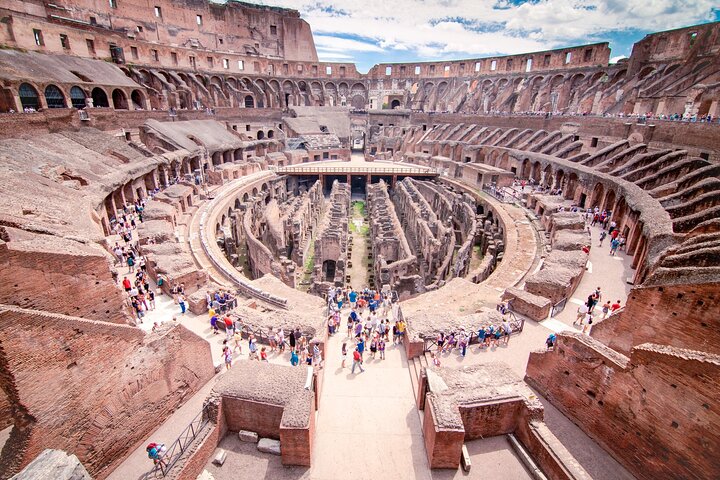
A gladiator experience tour uses the Colosseum as a starting point for an immersive exploration of gladiatorial combat as an institution — who gladiators actually were, how they trained, what motivated them, and what their lives and deaths meant to the Romans who watched them.
The distinction from a standard Colosseum tour is one of subject. A standard tour explains the building: its construction, its engineering, its seating, its history. A gladiator tour explains the people who fought in it and the culture that produced them, using the building as the setting rather than the subject.
Gladiatorial combat was the defining public spectacle of Roman culture, and it was a genuinely complex institution — combining athletic competition, religious ritual, social theatre and political propaganda in ways that fascinated and disturbed ancient commentators as much as they do modern ones. That complexity is what these tours set out to convey.
Who Were the Gladiators Really?
Contrary to popular mythology, most gladiators were professional fighters who survived multiple bouts and achieved significant fame and social status.
This is the single most important correction these tours make. The popular image — of doomed slaves fighting to certain death for the amusement of a bloodthirsty crowd — is substantially wrong. Gladiators were trained professionals, valuable assets, and in many cases public celebrities whose names and records were known to the crowd in the way modern athletes’ are.
Survival across multiple bouts was the norm rather than the exception. A fighter represented a considerable investment in training and upkeep, and the economics of the institution did not favour destroying that investment quickly.
The social position was genuinely strange, and ancient writers found it as difficult to categorise as modern historians do. Gladiators were legally degraded and socially marginal, yet simultaneously famous, admired and in some cases wealthy. That contradiction is one of the more interesting things a good guide can unpack.
How Did Gladiators Train?
Gladiators trained at dedicated schools known as ludi, on diets carefully managed for muscle mass and for the subcutaneous fat that absorbed sword cuts without fatal injury.
The dietary detail is one of the most revealing facts about the institution. A layer of subcutaneous fat provided a margin of protection — a cut that opened the skin dramatically, producing the visible blood the crowd expected, without necessarily reaching anything vital. Gladiators were, in other words, conditioned to bleed impressively and survive.
That single fact reframes the whole enterprise. It indicates a system designed to produce spectacle rather than slaughter, with fighters trained and fed to withstand the kind of wounds the crowd came to see.
The ludi were professional training establishments with their own hierarchies, trainers and specialisations, and they represented substantial commercial operations in their own right.
What Is the Ludus Magnus?
The Ludus Magnus was the largest gladiatorial training school in Rome. It stood directly adjacent to the Colosseum and is partially visible from the amphitheatre’s eastern entrance.
Its position is the striking thing. The principal training school sat immediately beside the principal arena — the fighters lived, trained and prepared within sight of the building they would fight in.
For visitors, the Ludus Magnus is easy to miss entirely. It is visible from the Colosseum’s eastern side as a partially excavated complex below street level, and without a guide pointing it out most people walk past without registering what it is. On a gladiator-focused tour it becomes a significant stop, because it is the physical evidence of the professional infrastructure behind the spectacles.
What Is the Gladiator’s Gate?
The Gladiator’s Gate is the Porta Libitinensis, the gate through which the dead were carried out of the Colosseum.
The name derives from Libitina, the Roman goddess associated with funerals and the dead. This was the exit used to remove bodies from the arena, a functional necessity in a venue staging combat and executions, and a fixed part of the choreography of the games.
Gladiator tours typically include a visit to it, and it tends to be one of the more affecting stops. Where the rest of the Colosseum speaks of spectacle and engineering, the Porta Libitinensis is a plain reminder of what the spectacle actually involved.
What Do Gladiator Tours Explain About the Fighting?
Gladiator tours provide detailed explanation of the different fighter types, their armament, their fighting styles, and the rules and conventions that governed bouts.
This is the technical substance of the tour and the part most visitors find unexpectedly interesting. Gladiatorial combat was not a free-for-all. It was a structured contest between defined fighter types, each with prescribed equipment and a characteristic fighting style, and matches were typically arranged between complementary types so that different advantages and vulnerabilities were set against each other.
The bouts were governed by rules and conventions, overseen by officials, and conducted according to expectations the crowd understood in detail. The spectacle worked precisely because the audience was knowledgeable — they followed the tactical logic of a match in the way a modern crowd follows a sport.
Understanding this structure is what converts the arena from a place where violence happened into a venue where a specific and highly developed contest was staged.
Do Gladiator Tours Include the Arena Floor?
Some gladiator tours include access to the arena floor for additional dramatic effect.
The addition suits this tour type particularly well. Standing on the level where the combat took place, having just been told how the fights were structured and who the fighters were, connects the subject matter to the physical space in a way the standard viewing walkways cannot.
Arena floor access requires a separate ticket and is not part of standard Colosseum admission, so it is worth confirming whether a given tour includes it. Availability is limited and these tours are booked in advance.
What Does a Gladiator Experience Tour Include?
A typical gladiator tour covers:
- Expert-guided access to the Colosseum
- The Gladiator’s Gate, the Porta Libitinensis through which the dead were carried
- The Ludus Magnus, visible from the Colosseum’s eastern entrance
- Detailed explanation of fighter types, their armament and fighting styles
- The rules and conventions that governed bouts
- The reality of gladiators’ lives — training, diet, status, fame and survival rates
- Optionally, arena floor access for additional dramatic effect
The distinguishing feature is depth on a single subject rather than breadth across the site’s whole history.
Who Are Gladiator Tours Best For?
Gladiator tours are particularly popular with two groups.
History enthusiasts, who want more depth on the institution than a general Colosseum tour provides. If you already know the building’s construction history, a gladiator tour supplies material a standard visit does not.
Families travelling with older children interested in ancient Roman culture. The subject matter is inherently engaging for children old enough to handle it, and the narrative focus on individual fighters, their training and their careers gives young visitors specific people to follow rather than abstract history.
The qualifier “older children” matters. The subject involves violence and death directly, and the tour discusses both frankly. For younger children a general family tour of the Colosseum is usually the better choice.
Practical Tips for a Gladiator Experience Tour
- Book in advance. Colosseum entry is timed and capped, and guided tours fill in peak season.
- Check whether arena floor access is included, as it requires a separate ticket and is not part of standard admission.
- Look for the Ludus Magnus on the Colosseum’s eastern side; it is easy to miss without a guide.
- Consider the age of your children. The subject matter suits older children better than younger ones.
- Wear comfortable shoes. The Colosseum involves stairs and uneven ancient surfaces.
- Bring water and sun protection, since much of the site is exposed.
Is a Gladiator Experience Tour Worth It?
For visitors whose interest in the Colosseum is really an interest in what happened inside it, a gladiator tour delivers what a standard visit does not.
The building itself is impressive on any tour. What a gladiator-focused tour adds is the correction of a widely held picture: that the fighters were doomed slaves rather than trained professionals, that bouts were chaotic rather than rule-governed, that death was the expected outcome rather than a managed risk within a spectacle designed to produce blood without routinely producing corpses.
That reframing makes the Colosseum a more interesting place, not a less disturbing one. A system that trained men to bleed convincingly and survive, that made celebrities of the legally degraded, and that combined athletic contest with religious ritual and political propaganda is stranger and more troubling than the simple version — and it is what the Romans actually built this building for.
For history enthusiasts and families with older children, it is among the most rewarding ways to visit the Colosseum.
Frequently Asked Questions
A gladiator experience tour uses the Colosseum as a starting point for an immersive exploration of gladiatorial combat as an institution — who gladiators actually were, how they trained, what motivated them, and what their lives and deaths meant to the Romans who watched them.
No. Contrary to popular mythology, most gladiators were professional fighters who survived multiple bouts and achieved significant fame and social status. A fighter represented a considerable investment in training and upkeep, and survival across multiple bouts was the norm rather than the exception.
Gladiators trained at dedicated schools known as ludi, on diets carefully managed for muscle mass and for the subcutaneous fat that absorbed sword cuts without fatal injury. The system was designed to produce spectacle rather than slaughter.
The Ludus Magnus was the largest gladiatorial training school in Rome. It stood directly adjacent to the Colosseum and is partially visible from the amphitheatre’s eastern entrance.
The Gladiator’s Gate is the Porta Libitinensis, the gate through which the dead were carried out of the Colosseum. Its name derives from Libitina, the Roman goddess associated with funerals and the dead.
Gladiator tours provide detailed explanation of the different fighter types, their armament, their fighting styles, and the rules and conventions that governed bouts. Combat was a structured contest between defined fighter types rather than a free-for-all, overseen by officials and followed knowledgeably by the crowd.
Some gladiator tours include access to the arena floor for additional dramatic effect. Arena floor access requires a separate ticket and is not part of standard Colosseum admission, so it is worth confirming whether a given tour includes it.
Gladiator tours are particularly popular with history enthusiasts and with families travelling with older children interested in ancient Roman culture. The subject matter involves violence and death directly, so it suits older children better than younger ones.